


 Call us
 Email us
Medically reviewed by Dr. Renu Grover, Pediatric, Squint & Neuro-Ophthalmology, Shroff Eye Centre
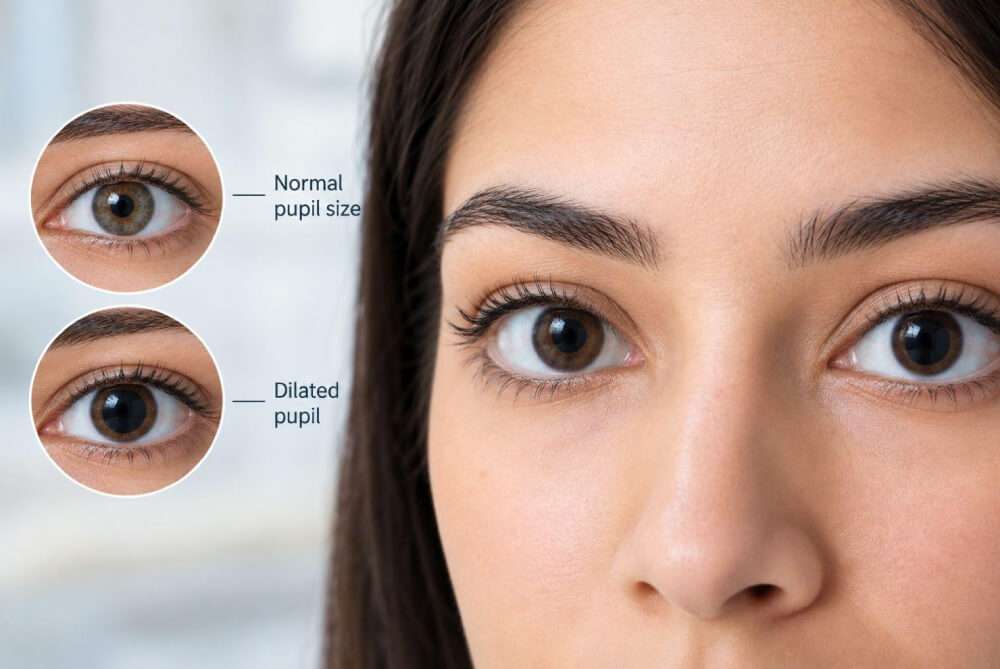
Our pupils naturally dilate in dim light and can also widen due to stress, medications or eye drops. However, sudden or unexplained changes in pupil size, particularly when one pupil is larger than the other (anisocoria), may require medical attention. Seek urgent medical evaluation if dilated pupils occur alongside severe headache, eye pain, blurred vision or other neurological symptoms.
Key Takeaways
- Dilated pupils (mydriasis) are pupils that are larger than normal in a normally lit room.
- Common physiologic causes include low light, mydriatic eye drops, stress and some medicines.
- A sudden, new difference in pupil size needs prompt evaluation.
- Sudden pupil changes accompanied by severe eye pain, redness, headache, vomiting or vision loss may indicate a medical emergency and require immediate evaluation.
What is the Pupil?
The pupil is the black circle in the centre of your eye. It is the opening in the iris (the colored part of the eye) which works like a camera’s aperture and controls how much light enters the eye and reaches the retina (the light-sensing layer at the back of the eye).
How Do Pupils Normally Work?
Your pupils adjust their size all day to control how much light enters your eye. Two muscles in the iris (the coloured part of your eye) control the pupil. One muscle (constrictor pupillae) constricts and reduces the pupil size, usually in response to bright light, to reduce the amount of light entering the eye. The other widens it (dilator pupillae), usually in response to dim light, to allow more light into the eye. Your autonomic nervous system controls both muscles automatically. You cannot change your pupil size voluntarily, ie like how you can move your hand or rotate your eyes when you want to.
Why Do Pupils Dilate in the Dark?
In dim light, your pupils widen to let more light reach the retina so you can see better. Dilation in the dark is a normal reflex and is the most common reason for large pupils. They should shrink again within seconds of returning to brighter light.
What Happens to Pupils in Bright Light?
In bright light, your pupils constrict (become smaller) to limit incoming light and protect the retina. A pupil that stays large in bright light, instead of shrinking,needs to be seen by a doctor. .
What Causes Dilated Pupils?
Dilated pupils are pupils that stay wider than expected for the amount of light around you. The medical term is mydriasis. It can affect one eye or both.
Some causes of dilated pupils are:
- Dim light around you (normal, physiological cause)
- During eye checkup (due to eye drops)
- Medication
- Acute Angle-Closure Glaucoma
- Eye trauma
- Head injury
- Brain tumours
- Neurological problems
- Fight-or-flight response (normal physiological response to extreme emotions)
- Recreational drug use
Eye Drops Used During an Eye Examination
Eye doctors use dilating drops to widen the pupil and examine the retina and optic nerve. After the drops, expect blurred near vision and light sensitivity for several hours. How long the effect lasts depends on the drop used (see the duration table below).
A dilated eye examination is a standard part of regular eye check-ups, especially if you have diabetes, high blood pressure or a family history of eye disease.
Medication that can cause dilated pupils
Some medicines can widen the pupils as a side effect, including:
- Eye drops: Tropicamide and phenylephrine.
- Stimulants: Amphetamines and methylphenidate.
- Anti-nausea medications: Scopolamine.
- Parkinson’s disease medications: Levodopa.
- Antihistamines: Diphenhydramine.
If you notice pupil changes after starting a medicine, speak to your doctor. Do not stop a prescribed medicine on your own.
Stress, Anxiety and Strong Emotions
Fear, excitement and anxiety trigger the fight-or-flight response. Adrenaline released during this response can widen your pupils for a short time. The dilation settles once the emotion passes, usually within minutes to a few hours.
Recreational Drugs and Alcohol
Stimulants such as cocaine and amphetamines, and hallucinogens such as LSD and MDMA, commonly cause dilated pupils. Alcohol can slow how quickly your pupils react to light.
Dilated pupils alone do not prove drug use. Darkness, medicines and stress are far more common causes.
Acute Angle-Closure Glaucoma
In acute angle-closure glaucoma, the drainage angle inside the eye suddenly blocks and eye pressure rises fast. The pupil often becomes mid-dilated and stops reacting to light.
Other symptoms may include:
- Severe eye pain
- A red eye
- Blurred vision
- Rainbow halos around lights
- Headache
- Nausea or vomiting
Acute angle-closure glaucoma is a medical emergency that requires immediate treatment to prevent permanent vision loss. Learn more about glaucoma diagnosis and treatment at Shroff Eye Centre.
Eye Injury or Trauma
A blow to the eye can damage the iris sphincter (the muscle that narrows the pupil). The pupil may then stay dilated or become irregular in shape. Sometimes the change is permanent. Any pupil change after an eye injury should be checked promptly.
Head Injury or Concussion
A significant head injury can raise pressure inside the skull and affect the nerves that control the pupil. A new dilated or unequal pupil after head trauma is a red-flag sign and you must seek immediate medical attention at a hospital equipped to handle head injuries
Neurological Conditions
Some nerve conditions affect the pathway between the brain and the iris:
- Adie’s tonic pupil: one pupil becomes larger and reacts slowly to light. The condition is usually harmless but needs confirmation by a specialist.
- Third nerve palsy: This condition can cause a dilated pupil, drooping eyelid and double vision. It may result from conditions such as an inflammatory disorder (arteritis), an infection, a brain aneurysm or other neurological problems. Sudden symptoms require urgent medical evaluation
- Stroke: A stroke occurs when the blood supply to part of the brain is interrupted (ischemia) or when a blood vessel in the brain bursts and causes bleeding (hemorrhage). In some cases, this can affect the nerves or brain areas that control pupil size, leading to changes in how the pupils respond to light. Pupil changes associated with neurological conditions may be evaluated by a neuro-ophthalmologist in coordination with a neurologist.
Brain tumor
A tumor in the brain can cause mass effects and compress important structures which control the dilation and constriction of the pupils.
If One Pupil Slightly Bigger Than the Other – Should I Worry?
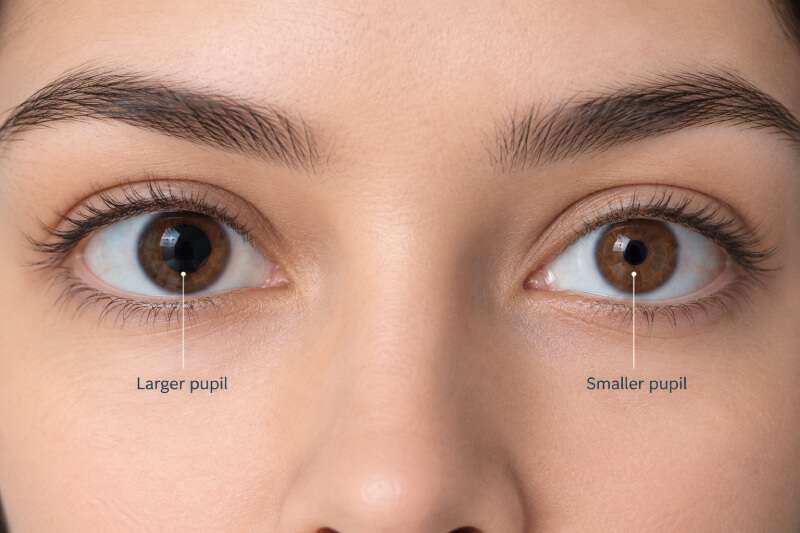
One pupil being larger than the other is called anisocoria.
If a doctor has evaluated the condition and found no underlying cause, it is known as physiological anisocoria. It affects around 20% of the population and is generally harmless. The difference in pupil size is usually very small.
All Anisocoria needs to be evaluated by an eye doctor. Seek urgent medical attention, especially if:
- You have suddenly or recently noticed a difference in pupil size.
- The difference is accompanied by symptoms such as headache, drooping eyelid, blurred vision, slurred speech or nausea.
- You have recently experienced a head or eye injury.
- You have a history of strokes or coagulation disorders in your family
Mydriasis vs. Miosis: What’s the Difference?
| Feature | Mydriasis (Dilated Pupil) | Miosis (Constricted Pupil) |
|---|---|---|
| Meaning | Pupil is wider than normal | Pupil is smaller than normal |
| Normal trigger | Dim light | Bright light |
| Common medicine causes | Dilating eye drops, antihistamines, decongestants | Opioid painkillers, glaucoma eye drops |
| Possible medical causes | Eye injury, angle-closure glaucoma, third nerve palsy, Adie’s pupil | Horner syndrome, eye inflammation, brainstem conditions |
| When it is concerning | Sudden, new onset, with or without other symptoms | Sudden, one-sided or not reacting to light |
Both dilation and constriction can be normal. The change matters more when it is unexpected, lasting or different between the two eyes.
What Symptoms Can Occur With Dilated Pupils?
Dilated pupils sometimes cause no symptoms at all. When symptoms do appear, they depend on the cause and may include:
- Blurred vision, especially up close
- Sensitivity to light (photophobia)
- Difficulty focusing on near objects
- Eye pain or a red eye
- Headache
- Double vision
- Drooping eyelid
- Nausea or dizziness
- Noticeably unequal pupils
How Can You Check Your Pupils at Home?
You may notice differences in pupil size when looking in a mirror or comparing photographs taken in similar lighting conditions. However, checking your pupils at home cannot determine the underlying cause or rule out an eye or neurological condition.
If you notice a difference in pupil size:
- Look at both pupils in a mirror under normal, even lighting.
- Compare the size of both pupils and check whether the difference is noticeable.
- Note when you first noticed the change.
- Pay attention to any accompanying symptoms, such as headache, blurred vision, eye pain, drooping eyelid or double vision.
Remember: A home check cannot replace a professional eye examination. If you notice a sudden or unexplained change in pupil size, particularly in one eye, seek urgent medical evaluation. Do not delay medical attention to perform a home check.
When Are Dilated Pupils an Emergency?
| Situation | What to Do |
|---|---|
| Pupils widen in darkness and shrink in bright light. | This is a normal response and generally does not require medical attention. |
| Pupils become dilated after an eye examination. | Expected; wear sunglasses and avoid driving until vision clears |
| Pupils dilated after prescribed medication | Don’t stop medication on your own, contact your doctor and check with them |
| A small, lifelong difference in pupil size | Usually normal if pathological causes have been ruled out by a doctor; |
| Persistent or unexplained Dilated pupil with no other symptoms | Book an eye checkup with a neuro-ophthalmologist. Sudden changes require urgent assessment. |
| Dilated pupil with any other symptoms- eye pain, red eye, halos, headache, nausea, confusion, weakness, change in speech etc | Seek emergency medical care immediately |
| New unequal pupils after a head or eye injury | Seek emergency medical care immediately |
Remember: If you notice a sudden change in pupil size, particularly in one eye, do not wait for other symptoms to appear before seeking medical evaluation.
Need a neuro-ophthalmology evaluation? ?
Our specialists are available at Kailash Colony, Connaught Place, Gurgaon and Ghaziabad.
How Do Eye Doctors Diagnose the Cause of Dilated Pupils?
Your eye doctor will first ask about your medications, recent injuries, use of eye drops and when you first noticed the change in pupil size. The examination may include the following tests:
- Visual Acuity Test: Checks how clearly you can see.
- Eye Pressure Measurement (Tonometry): Measures the pressure inside your eyes and helps screen for conditions such as angle-closure glaucoma.
- Pupil Light Reaction Test: Checks how each pupil responds to light in both dim and bright conditions.
- Slit-Lamp Examination: Provides a magnified view of the iris and the front structures of the eye.
- Dilated Retinal Examination: Allows the doctor to examine the retina and optic nerve.
- Optical Coherence Tomography (OCT): Produces detailed images of the retina and optic nerve to identify any structural abnormalities.
- Visual Evoked Potential (VEP) and Electroretinography (ERG): Specialised tests that assess the function of the visual pathways and the retina, respectively.
- Brain Imaging (MRI or CT Scan), With or Without Contrast: May be recommended when necessary to investigate possible neurological causes or rule out other underlying conditions.
How Are Dilated Pupils Treated?
Treatment depends on the cause, not on the amount of dilation itself. Usually if no cause is found, your specialist may choose to just observe. Depending on the cause, an intervention may be required. For example acute angle closure glaucoma will be treated with medication or laser treatment, an aneurysm in the brain may need surgical intervention etc.
People with a permanently dilated pupil may use tinted glasses or specialised contact lenses to reduce glare.
Myths vs. Facts About Dilated Pupils
Do dilated pupils always mean drug use?
No. Dilated pupils can occur due to several reasons, including darkness, certain medications, eye drops and stress.
Are dilated pupils always dangerous?
No. Most cases are temporary and harmless. However, only a doctor can determine whether the cause is harmless or requires medical attention. Urgent evaluation may be necessary in certain cases.
Do unequal pupils always indicate a serious problem?
No. Around 1 in 5 people have a small, lifelong difference in pupil size, known as physiological anisocoria. However, an eye doctor should evaluate the condition to determine whether it is physiological or caused by an underlying problem.
Can you identify the cause of dilated pupils at home?
No. Although you may notice changes in your pupil size, only a doctor can properly evaluate the condition and determine its underlying cause.
Frequently Asked Questions
Q: Why are my pupils dilated?
The most common causes are low light, a recent eye examination where dilating eye drops were used, certain medicines and strong emotions. All of these are temporary. Sudden or unexplained dilation, especially in one eye, needs to be evaluated by a doctor.
Q: Can stress or anxiety cause dilated pupils?
Yes. Stress and anxiety trigger the fight-or-flight response, which releases adrenaline. Adrenaline can widen your pupils for some time. The dilation settles as you calm down.
Q: How long do dilated pupils last after an eye exam?
Routine eye exam drops usually wear off in 4 to 8 hours. Stronger drops used for children can last up to 24 hours. Some eye drops can keep pupils dilated for 7-10 days.
Q: Can I drive after my pupils are dilated?
Dilating eye drops can cause blurred vision and light sensitivity for several hours. Avoid driving until your vision has returned to normal and you can drive safely. It is best to arrange alternative transport after your appointment.
Q: Can dilated pupils affect vision?
Yes. You may notice blurred near vision, glare and light sensitivity until your pupils return to normal size.
Q: Can dilated pupils happen after a head injury?
Yes. A head injury can affect the area or path of the nerves that control your pupillary muscles. A new dilated or unequal pupil after head trauma needs emergency medical care straight away.
Q: Can glaucoma cause dilated pupils?
Yes sometimes. In acute angle-closure glaucoma, the pupil often becomes mid-dilated and stops reacting to light, with severe eye pain and nausea. Know the warning signs of glaucoma and treat sudden symptoms as an emergency.
Q: Should I worry about dilated pupils in a child?
Normal dilation in dim light is not a concern. Sudden, persistent or unequal pupils need a evaluation by a paediatric ophthalmologist, especially after an injury.