


 Call us
 Email us

Wet Age-Related Macular Degeneration (Wet AMD) is an eye condition that causes blurred or reduced central vision. It happens when abnormal blood vessels grow under the retina and leak fluid or blood into the macula, the part of the eye responsible for sharp central vision , can be affected by several retinal conditions such as Macular Hole and macular degeneration.
Age-related macular degeneration has two types: dry AMD and wet AMD. Dry AMD is more common and develops slowly, while Wet AMD is less common but can cause faster vision loss if not treated early.
Early diagnosis and treatment can help slow vision loss and protect remaining vision
What Are the Symptoms of Wet AMD?
The retina’s function is to transfer light signals from the eye to the brain. Cells in the retina help us ‘see’ light and also colour. The macula of the eye is the central part of the retina, responsible for your sharp vision.
The growth of abnormal new blood vessels from the choroid under and into the macula is called choroidal neovascularization. (The choroid is a normal layer of blood vessels between the retina and the outer, firm coat of the eye called the sclera).
Wet AMD is generally caused by the growth of abnormal blood vessels in the retina and macula. These abnormal vessels leak fluid or blood into the macula and cause a bump with swelling in the macula, resulting in vision loss & vision distortion.
Who is at risk of wet Age-related macular degeneration?
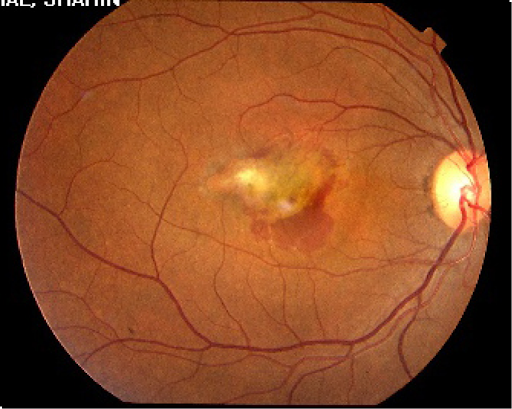
You are more likely to develop AMD if you
- Age: The risk increases with increasing age, those over 60 years of age are at a higher risk.
- Have a family history of macular degeneration
- Have high blood pressure
- Have heart disease
- Smoke cigarettes
- Are overweight
- Are Caucasian
Age is the most important risk factor, and the condition is more common in older adults.
What Are the Symptoms of Wet AMD?
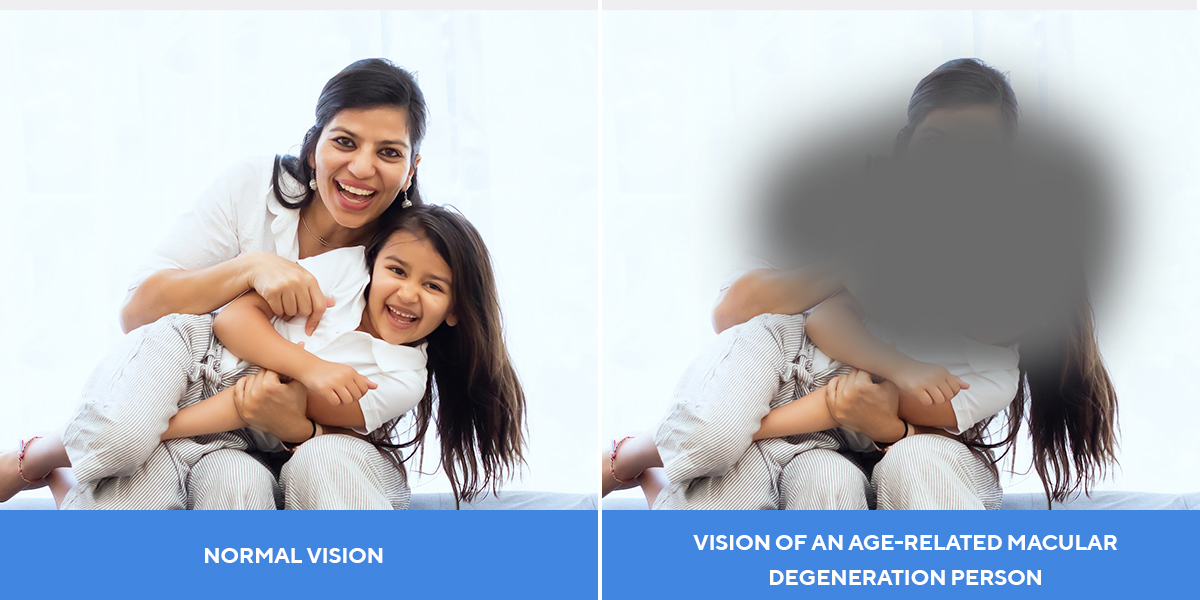
Wet AMD usually presents with worsening vision. This is because the macula or the central part of the retina is involved and the disease is progressing.
Symptoms of Wet AMD usually appear suddenly and may worsen quickly.
Common symptoms include:
- Loss of color vision
- Difficulty in reading smaller text on mobile screens, books or recognising faces
- Straight lines appearing wavy or crooked
- Difficulty in seeing in low light
- A dark spot or loss of vision in the centre of their vision.
Wet AMD mainly affects central vision, while side vision usually remains normal.
How Is Wet Age-Related Macular Degeneration Diagnosed?
To diagnose Wet AMD, our doctors will order some tests such as
- Visual Acuity Test to measure vision clarity
- Amsler Grid to detect distorted vision
- Dilated Retina Check up by our retina specialists
- Optical Coherence Tomography (OCT) to check retinal swelling
- Optical Coherence Tomography- Angiography (OCT-A) to examine blood vessels
- Fluorescein Angiography (FFA) to identify leaking blood vessels
Want to know more? Read this (AMD Diagnosis on macular degeneration page)
What is the Wet Age-Related Macular Degeneration Treatment?
Wet AMD is a rapidly progressive retina problem which needs early treatment.
The gold standard treatment method is intravitreal anti-VEGF injections which help stop abnormal blood vessel growth and reduce fluid leakage.
Other methods are laser photocoagulation, photodynamic therapy, intravitreal steroids and or a combination of these. The aim of treatment is to slow down the rate of vision loss or stop further vision loss. Our retina surgeon specialists in Delhi NCR will help you decide the best course of action.
Find out more about Macular degeneration treatment in Delhi NCR here.
Read more about AMD & its prevention Treatment here.
Frequently Asked Questions about Wet AMD
Q. What causes wet age-related macular degeneration?
Wet age-related macular degeneration happens when abnormal blood vessels grow under the retina and leak fluid or blood into the macula. This damages the part of the eye responsible for sharp central vision.
Q. How is wet macular degeneration treated?
The most common treatment for Wet AMD is anti-VEGF injections, which help stop abnormal blood vessel growth and reduce leakage in the retina. Early treatment can help slow vision loss.
Q. Can wet macular degeneration be cured permanently?
There is currently no permanent cure for Wet AMD. However, treatments can help control the condition, slow disease progression, and preserve vision.
Q. What are the early warning signs of wet macular degeneration?
Early signs may include blurred central vision, straight lines appearing wavy, difficulty reading, and dark spots in the center of vision.
Q. Can wet macular degeneration cause blindness?
Wet AMD usually affects central vision, but it typically does not cause complete blindness because side vision remains intact.
Q. Can lifestyle changes help reduce the risk of macular degeneration?
Healthy habits such as quitting smoking, maintaining a balanced diet, controlling blood pressure, and regular eye checkups may help reduce the risk of macular degeneration.
Disclaimer: This information is not intended to constitute or be a substitute for professional medical advice, diagnosis or treatment. Always seek the advice of your doctor or another qualified healthcare provider with any questions you may have regarding your medical condition. Never disregard professional medical advice or delay in seeking it because of something you have heard in a video or read about on a blog or website.
/