



| |
|
|
| |
Implantable Contact Lens (ICL) / Phakic
IOL for the Correction of High Myopia, High Hyperopia and Astigmatism
|
|
| |
|
|
| |
If
your glass power is too high, or if your corneas are too thin, then
you are probably unsuitable for LASIK or even epi-LASIK. Shroff Eye
Centre and its dedicated team of refractive surgeons offer you a safe
alternative. The Implantable contact Lens (ICL) is a new and safe
treatment option for patients with extremes of myopia (near-sightedness)
and hyperopia (far-sightedness).
Click for Appointment |
|
| |
|
|
| |
Learn more about the Implantable
Contact Lens (ICL) - THE ULTIMATE CHOICE IN VISION CORRECTION. |
|
| |
What is an Implantable
Contact Lens (ICL)? |
|
| |
How does the ICL work? |
|
| |
Who should consider
the ICL / Am I suitable for the ICL? |
|
| |
The Consultation |
|
| |
The ICL Procedure |
|
| |
After Treatment |
|
| |
Limitations of ICL /
Phakic Implant Surgery |
|
| |
What problems have been
encountered with ICLs? |
|
| |
The Advantages of ICL
Implantation |
|
| |
The ICL - The Ultimate
Choice, Even for Doctors Themselves |
|
| |
Frequently Asked Questions |
|
| |
|
|
| |
What is an Implantable
Contact Lens (ICL)? |
|
| |
The
Implantable Contact Lens (ICL) is indicated for patients unsuitable
for LASIK with extremes of myopia (near-sightedness), hyperopia
(far-sightedness) and/or astigmatism (cylindrical powers).
They are designed to correct visual problems much the same way
as an external contact lens. Unlike external contact lens, Implantable
Contact Lenses are placed inside the eye behind the iris (colored
part of the eye) and in front of the eye's natural lens. Unlike
LASIK, the ICL is a reversible procedure.
It is an artificial lens made from material similar to the type
used for intraocular lenses currently being implanted in cataract
surgery that is placed inside your eye in addition to your natural
lens.
|
|
| |
|
|
| |
How does the ICL
work? |
|
| |
The Implantable Contact Lens is a very thin, foldable lens, which
is inserted into the eye through a tiny sutureless corneal incision
during a 30-minute local anesthetic procedure. Each ICL is specially
designed and custom-made to fit the patient's own unique anatomy.
It lies behind the iris and in front of the lens, without touching
the central lens. The ICL is reversible and can correct near-sightedness,
far-sightedness and astigmatism.
|
|
| |
Go back
to the top » |
|
| |
Who should consider
the ICL / Am I suitable for the ICL? |
|
| |
Because each person's eyes are different, your surgeon
must choose the best treatment for your specific disorder. The Implantable
Contact Lens (ICLTM) is capable of correcting most refractive disorders
as well as those where conventional laser treatment (LASIK, PRK, etc.)
may not be advisable. Implantable Contact Lenses are best suited for
patients with high nearsightedness or high farsightedness with problems
wearing contact lenses. More specific guidelines of ICL eligibility
could include:
Extreme nearsightedness (especially if thin corneas would raise
the risk of LASIK-induced problems)
Extreme farsightedness
Corneas too thin to have safe LASIK or even Epi-LASIK
Older than 21 years with a stable refraction for 2 years or more
and not pregnant
Dry eyes or large pupil
|
|
| |
|
|
| |
The Consultation |
|
| |
ICL work-up and treatment at Shroff Eye Centre is performed
by our experienced staff and surgeons. An initial consultation will
confirm suitability. Each patient then goes through a comprehensive
series of eye tests and examinations (including manifest, cycloplegic
and post-mydriatic refraction, corneal topography, pachymetry, and
thorough retina check-up) before consulting with the surgeon to discuss
and plan the specifics of personal vision correction. If one decides
to go ahead with the treatment, the lenses will be made to the exact
specifications and will be ready in two weeks. If you wear contact
lenses, you will be required to stay off them prior to your check-up
(Soft lenses for 2 weeks and rigid lenses for 4 weeks).
|
|
| |
|
|
| |
The ICL Procedure |
|
| |
As
part of the pre-operative work-up your surgeon will perform YAG
Laser Iridotomy before the actual procedure, which consists of making
two holes in your colored portion of the eye (Iris) to help ensure
that intraocular fluid does not build up behind the ICL.
Prior to the ICL procedure you will be started on pre-operative
medication including antibiotic drops, as per the surgeon's requirements.
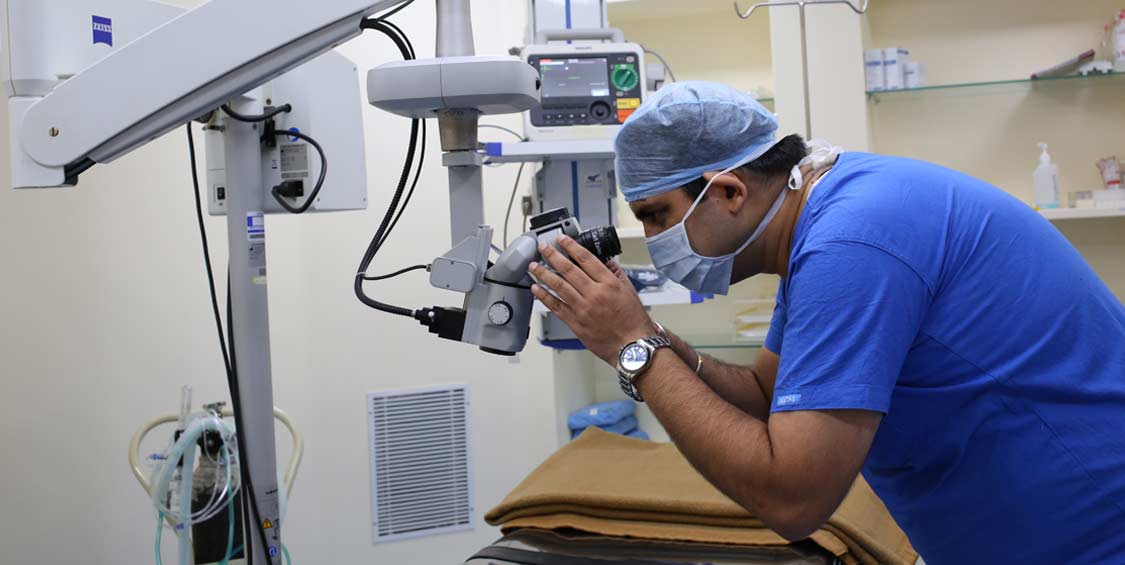
The ICL implantation procedure is performed in a specialist ophthalmic
theatre. Local anesthetics will be used to numb the eye.
The lens is inserted through a small incision in the side of the
cornea and sits in front of the eye's natural lens, just behind
the cornea. Antibiotic and anti-inflammatory drops are then administered
to avoid infection and the whole procedure takes around 30 minutes.
As a precautionary measure, the lenses are implanted one at a time,
allowing a minimum recovery time of one week between treatments.
Once the first has fully settled, the second eye receives its ICL.
|
|
| |
Go back
to the top » |
|
| |
After
Treatment |
|
| |
You will be able to go home on the same day and it
is essential that you have someone to accompany you. You are free
to leave the clinic as soon as you feel able, with padding over the
eye to prevent infection. Although you may see some improvement in
your vision as early as the first postoperative day but visual recovery
may take several weeks to stabilize. You will be able to return to
normal activities within 2-3 days following surgery and should be
able to drive and be back to work within two weeks of the procedure.
You will need to be seen again by your surgeon on the day after surgery.
Aftercare visits are required after one and three months, then as
directed by the surgeon. |
|
| |
|
|
| |
Limitations of ICL
/ Phakic Implant Surgery |
|
| |
Results of surgery cannot be guaranteed and sometimes glasses may
be required for sharpest vision, for night driving or other activities
performed in low light, and for prolonged reading etc. Implantable
Contact Lenses are designed to provide as close to normal vision
as possible. People with normal distance vision benefit from wearing
reading glasses for near work at some stage in their 40s. ICL patients
experience this aging change just the same as normal people.
|
|
| |
Go back
to the top » |
|
| |
What problems have
been encountered with ICLs? |
|
| |
There is a small but unavoidable risk of infection but this is
minimized by the full sterile theatre conditions. There is also
a small possibility of damage to the structure of the eye, which
could lead to cataracts, glaucoma, retinal complications, corneal
decomposition and rejection.
Severely short-sighted people often have other eye problems such
as damaged retinas and progressively deteriorating eyesight. The
ICL cannot help or stop these associated conditions. In the event
of complications, lens implants are potentially reversible
No procedure can be risk-free. Ultimately, the patient needs to
make up their mind about the risk/benefit balance for the various
options available to them to correct their high myopia or high hyperopia.
Some patients need surgical correction of their severe focus error
for safety reasons. Theoretically, the proximity of the ICL to the
iris and lens raises the possibility of late onset lens opacities
or pigment dispersion. Both these rare but potential problems (occurred
in 0.4% patients in the FDA Study Group) are much more easily fixed
than corneal complications following LASIK surgery. Current evidence
supports ICLs as being a very effective and safe option for these
patients.
The Implantable Contact Lens is designed to be placed in your eye
and remain there permanently, but with increasing age if you develop
a cataract significant enough to cause visual problems, then cataract
removal with intraocular lens implantation can be done with removal
of the ICL.
|
|
| |
|
|
| |
The Advantages of
ICL Implantation |
|
| |
1. The ICL is tiny and soft - The ICL can be folded so small that
it can be injected painlessly into your eye in seconds through a
tiny opening in your cornea so that it unfolds into position in
the liquid between your iris and your natural lens and is easily
accepted by your body.
2. The ICL is invisible - The ICL is placed inside your eye, rather
than on the surface. The lens is invisible. The only way that you
or anyone else will know that it is there, is the improvement in
your eyesight.
3. ICL is removable - The lens is meant to remain permanently in
the eye. However, it can be removed if necessary, since the lens
does not alter any structures within the eye or the cornea.
4. The ICL works beyond the limits of laser treatment - The ICL
is useful in cases beyond the limits of laser treatment (high minus
and plus spectacle powers) and is the treatment of choice if you
have thin corneas, dry eyes, or large pupils.
5. The Toric ICL treats two vision disorders in one procedure -
The Toric ICLTM corrects you nearsightedness as well as your astigmatism
in one single procedure. Each lens is custom made to meet the needs
of each individual person.
6. The ICL provides high patient satisfaction - The ICLTM provides
high quality of vision, and is a highly precise and predictable
treatment providing exceptional patient satisfaction.
|
|
| |
Go back
to the top » |
|
| |
The ICL - The Ultimate
Choice, Even for Doctors Themselves |
|
| |
Surgeons around the world have made the ICLTM their procedure of
choice more than 65,000 times - not only for their patients, staff
and family, but even for themselves.
|
|
| |
Go back
to the top » |
|
| |
FREQUENTLY ASKED
QUESTIONS |
|
| |
Q Am I a candidate for the ICLTM?
A Yes, if you have nearsightedness, and / or astigmatism
and no eye disease. ICL for farsightedness is also available.
Q What are the advantages of the ICLTM?
A lens is small, foldable, and injected through a tiny, pain
free, self healing incision in your eye. ICLTM provides highly predictable
outcomes, excellent quality of vision and can be removed if necessary.
Q How quickly can I go back to my daily routine & activities?
A Due to the quick recovery after this treatment, you can leave
the centre after a couple of hours. You will be able to enjoy your
new sight almost immediately and go back to your active lifestyle.
Your surgeon will give you detailed advice.
Q What if my vision changes?
A Though unlikely, if during your annual eye exam a major
change in your vision is observed, the ICLTM can be removed or replaced.
With the ICLTM you can still wear glasses or contact lenses if necessary.
The lens does not treat presbyopia or eliminate the need for reading
glasses due to age.
Q What is the long-term experience with ICLTM?
A The ICLTM has been available internationally for over 12 years.
More than 65,000 lenses have been implanted since then.
The ICL thus provides a high quality of vision, and is a highly
precise and predictable treatment providing exceptional patient
satisfaction for patients unsuitable for LASIK
|
|
| |
|
|
| |
|
|
| |
For further information consult The Refractive Surgery Service at Shroff Eye Centre |
|
| |
|
|
| |
Go back
to the top » |
|