

 Call us
 Email us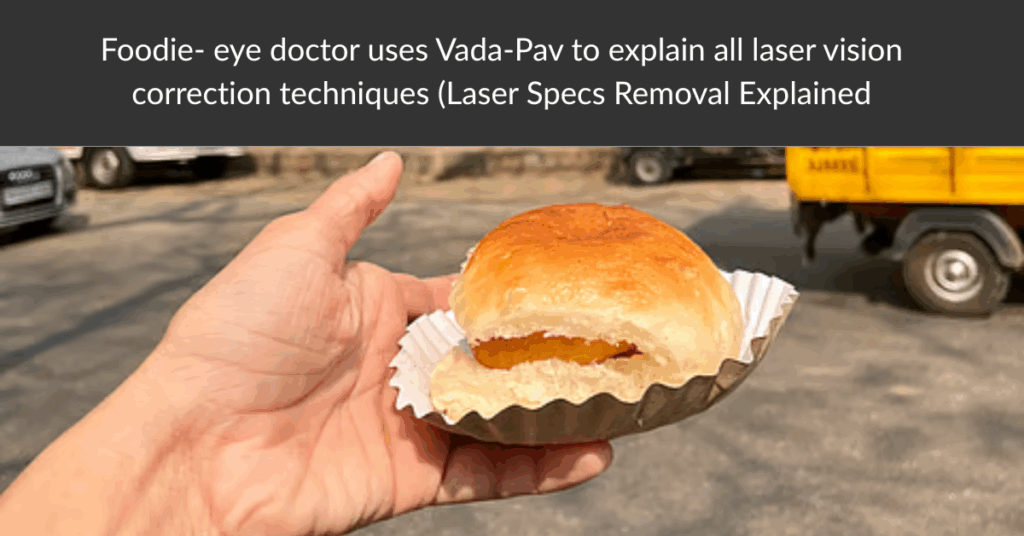
Date: February 2026
Category: Laser specs removal/ Eye Health / Medical Humor
Reading Time: 2 mins, Watch Time: 1 Minute
We get it, medical terms and eye surgery terminology sound strange and terrifying . “Flaps,” “Excimer,” “Lenticules”… it sounds like sci-fi. But you know what isn’t scary? A Vada Pav.
In this genius short video from Shroff Eye Centre, Dr. Rushad Shroff takes one of his favorite snacks and turns it into the perfect anatomy/ eye surgery lesson. If you’ve ever been confused about the difference between SILK, SMILE, LASIK, and PRK, this “delicious” explanation is exactly what you need.
Here is the step-by-step breakdown of the video (and yes, a Vada Pav was harmed in the making of this video & blog).
The Vada Pav Analogy: Understanding SILK, SMILE, LASIK & PRK in Simple Terms
The Vada Pav = Your cornea: The vada pav acts as the top layer of your eye called the Cornea (the front transparent part in front of your eye).
The Goal: Reshaping the cornea to correct your vision so you don’t need glasses.
Let’s explore laser vision correction!
Here is exactly what happens in the video, translating the snack-tion into medical facts.
In the video, Dr. Rushad Shroff uses a simple Vada Pav analogy to explain how laser vision correction works. He compares the bun to the cornea, which is the clear front surface of the eye where all laser specs removal procedures are performed.
The Treatment Techniques:
- SMILE/SILK: The “Keyhole” surgery (no flap).
- LASIK: The “Flap” surgery (lift and treat).
- PRK/ Streamlight: The “Surface” surgery (no flap, surface remodelling).
Technique 1: The “Keyhole” Method (SILK, SMILE, CLEAR or any lenticular extraction procedure for specs removal)
Visual: A laser pointer highlights the center of the bun. The doctor uses forceps to reach inside the bun and pulls out a tiny piece of the filling.
What Actually Happens in SILK/ SMILE/ CLEAR: The femto laser creates a microscopic disc (lenticule) inside the cornea layers and a tiny keyhole incision on top. The eye surgeon removes this disc through a tiny keyhole incision. This corrects the shape of the cornea and corrects eye power.
Why it’s cool: No flaps! It’s minimally invasive with quick recovery and great for those with active lifestyles.
Technique 2: Blade-Less LASIK (Covers procedures such as Wavelight, iLASIK, Schwind Amaris)
Visual: The top half of the bun is cut with laser (with one laser) and lifted up like a flap. The second laser treats the corneal layers below (pav), and the bun top is put back.
What Actually Happens in Wavelight Contoura, iLASIK, Schwind Amaris: A femtosecond laser creates a thin flap on the top layer of the cornea. We lift it, reshape the cornea underneath with an excimer laser to fix your eye power, and put the flap back. Flap heals, seals and eye power is corrected.
Why it’s cool: Fast recovery. You see clearly almost immediately.
Technique 3: Streamlight PRK (popularly called Touchless LASIK or TransPRK)
Visual: The top “skin” of the bun is completely removed by the laser, the inside is treated by the laser, and healing requires we wait for the skin to grow back.
What Actually Happens in Streamlight PRK (popularly called Touchless LASIK or TransPRK): There is no flap. A laser precisely removes the ultra-thin top layer (epithelium) of the cornea and a second laser reshapes the underlying cornea. The epithelium grows back naturally in a few days, correcting eye power.
Why it’s cool: Great for people with thin corneas or active sports lifestyles.
Technique 4: Conventional PRK (EpiContoura)
Visual: A chemical is applied to the bun to loosen the top skin of bun, which is then removed and the lower layers are then treated by another laser
What Actually Happens in: Similar to Streamlight, but instead of a laser removing the top layer or epithelium, a safe chemical solution is used. The laser then corrects the power by treating the underlying cornea, and the eye power is corrected once this epithelium heals naturally.
Technique 5: Blade LASIK (The old classic)
Visual: A physical blade tool lifts the bun flap and the laser treats the part underneath.
What Actually Happens: A device called a Microkeratome (a kind of blade) creates the corneal flap instead of a femto laser. The excimer laser then corrects the shape of the cornea. The flap is replaced and it heals naturally.
Why Choose Shroff Eye Centre for specs removal eye Surgery in Delhi NCR?
Shroff Eye Centre is trusted for specs removal eye surgery because:
Use the Latest laser technology globally (Elita SILK, Wavelight)
More than 3 decades of experience with specs removal Refractive eye surgery
Amongst the first hospitals to start refractive surgery in North India
More than 500000 happy patients
Treatment plans customised specially for your eyes
Focus on ethical patient care
Personalised post operative care and support
Easy access to hospitals across Delhi NCR
Shroff Eye Centre is among the most recognised names for specs removal refractive eye surgery in Delhi NCR.
Conclusion: Which Flavor is Yours?
Just like you might prefer extra chutney but it is not good for you, the right surgery depends on your eye measurements and your visual needs.
- Want the quickest recovery with not very high eye power? SILK or LASIK.
- Have thinner corneas? Streamlight or PRK might be a safer bet.
- Scared of blades? Go Blade-less (Femto) LASIK or SILK/SMILE.
- Very active lifestyle or in combat professions? SILK, Streamlight or PRK may be better.
Ready to Ditch Specs?
If you are tired of cleaning fogged-up glasses and want a life free of specs, come get a consultation. We promise to tell you where to get yummy vada pav too!
📍 Visit Shroff Eye Centre (Serving Delhi, Noida, Faridabad, Gurgaon & Ghaziabad) 👉 Book Your Appointment Here
Frequently Asked Questions
1. What is the difference between SILK, LASIK and PRK?
- SILK is a keyhole procedure with no flap.
- LASIK creates a flap and reshapes the cornea underneath
- PRK treats the surface of the cornea without creating a flap.
2. Which laser eye surgery is best for specs removal?
There is no single best option. The right procedure depends on your eye power, corneal thickness, and lifestyle.
3. Is SILK better than LASIK?
SILK has no flap and is minimally invasive. LASIK offers very fast visual recovery. Your doctor will suggest what suits your eyes.
4. Is PRK good for thin corneas?
Yes. PRK is often recommended for patients with thinner corneas because no flap is created.
5. Is laser eye surgery painful?
No. The procedure is painless because numbing drops are used. Mild irritation may happen for a few days.
6. How long does recovery take?
Most patients see clearly within 1–2 days after SILK or LASIK. PRK may take a few extra days to heal.
7. Is laser specs removal surgery safe?
Yes. It is a safe and widely performed procedure when done after proper eye evaluation.
8. Who is eligible for laser eye surgery?
People above 18 years with stable eye power and healthy eyes are usually eligible after detailed testing at eye centre.
Blog Medically reviewed by Dr. Rushad Shroff – Refractive and Cornea Surgeon, Shroff Eye Centre, Delhi NCR.