


 Call us
 Email us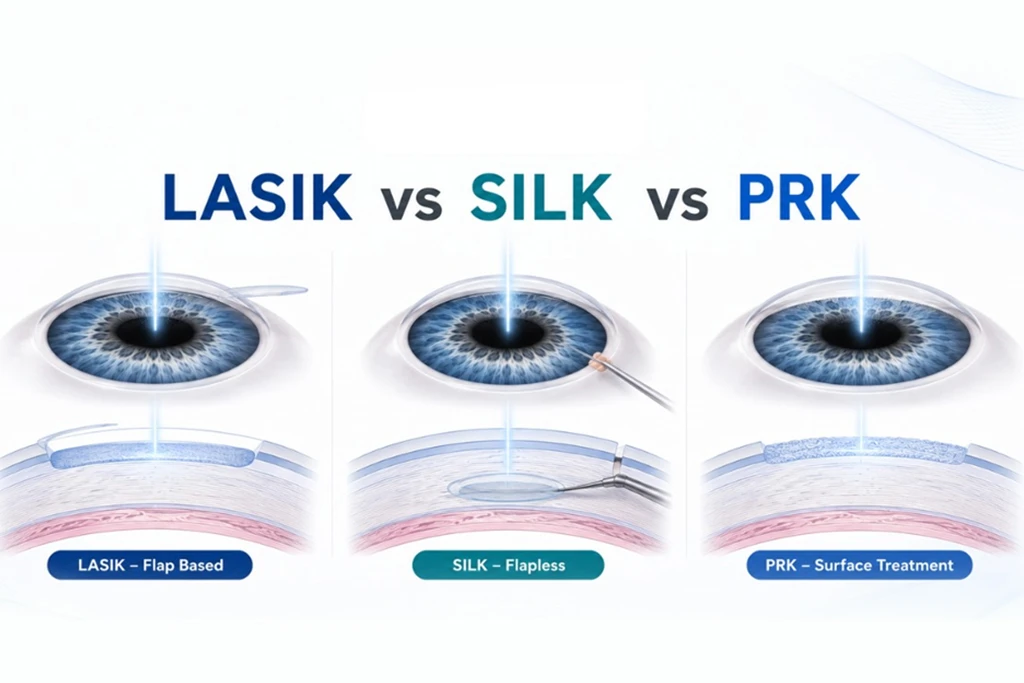
Medically Reviewed by Shroff Eye Centre’s Refractive Team
At a Glance
- LASIK, EpiLASIK and SILK are all laser procedures used to remove glasses and correcting vision by reshaping the cornea.
- LASIK gives the fastest recovery and most people see clearly within 24–48 hours.
- EpiLASIK is better for thinner corneas and active lifestyles as no flap is made, but recovery takes longer.
- SILK is an advanced, flap-less option for those with active lifestyles and has advantage of no flap displacement, lower chances of dry eyes and quick recovery.
- There is no single best option. All three are excellent options and best surgery depends on your corneal parameters, eye power, dryness and lifestyle.
- Final decision is made only after detailed eye tests and doctor evaluation.
If you are planning to get rid of your glasses, you may have come across LASIK, PRK (EpiLASIK) and SILK eye surgery. These are all laser procedures used to correct vision and remove your dependence on glasses. However they differ in the technique, recovery and patient suitability profile. Read on to understand the differences between LASIK, EpiLASIK and SILK and discuss the right option with your eye specialist.
Quick Comparison guide
| Procedure | Technique | Pros | Cons | Corrects eye power | Machine used |
| LASIK | Flap | – Fast recovery (24–72 hrs) – No pain |
– Flap displacement risk – Dry Eye (temporary) – Light sensitivity (temporary) – Not for thinner corneas, sportspersons or armed forces |
Myopia Hypermetropia, Astigmatism |
Elita femtosecond laser + Wavelight excimer laser |
| EpiLASIK | Flap-less | – No risk of flap displacement – Lower risk of dry eye – Thin corneas, sportspersons, armed forces |
– Slower recovery(5-7 days) – Discomfort & a little pain during recovery – Glare & halos (temporary) |
Myopia Hypermetropia, Astigmatism |
Wavelight excimer laser |
| SILK | Lenticule, Flap-less | – Fast recovery (24-72 hours) – No pain – Excellent for Active lifestyles, sportspersons, armed forces |
– Dry eye (temporary) – Light sensitivity (temporary) |
Myopia, Astigmatism |
Elita femtosecond laser |
*Vision recovery is variable as it is dependent on your corneal biomechanics. These are the timelines for recovery for the majority of people.
LASIK: Fast Recovery and Broad Eligibility
LASIK is a popular refractive surgery for removal of glasses.
- LASIK is better for: LASIK is better suited to those with adequate corneal thickness, those who do not play contact sports, armed forces or are not in certain professions like aviation or combat.
- LASIK can correct myopia (up to -10D), hypermetropia (up to +5D) with or without astigmatism depending on your corneal parameters.
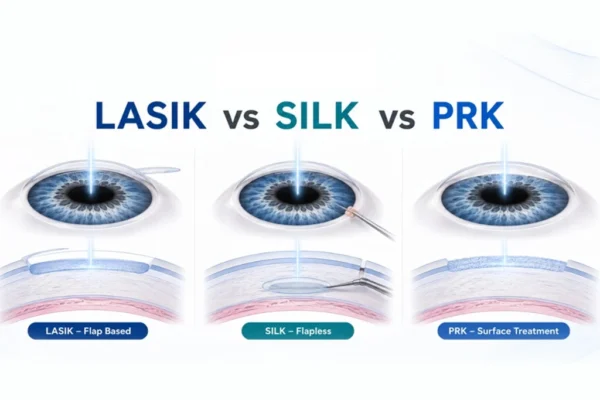
- LASIK procedure: A thin corneal flap is made on the surface of your cornea (usually femto laser is now preferred for this- called bladeless LASIK) and a laser is used to reshape the tissue underneath. The eye surgeon gently replaces the corneal flap into its place. No stitches are used and the flap heals naturally. This procedure takes about 15-20 minutes.
- LASIK Recovery: Recovery is quick and most people have clear vision within 24-72 hours. Most patients have crisp and clear vision within a week but final sharp vision may take 1-3 months.
- LASIK pros & cons: There is usually no pain during the procedure or afterwards during recovery. Patient outcomes and satisfaction rates are very high if instructions are followed properly. Temporary dry eyes and temporary problems in night driving may be experienced by some patients. There is also a small risk of flap displacement.
At Shroff Eye Centre, Elita femto second laser is used for creating the corneal flap and Wavelight excimer laser is used to reshape the cornea. Read more about LASIK here
PRK (EpiLASIK) : Better for Thinner Corneas and Active Lifestyles
PRK, also called EpiLASIK, is a surface ablation procedure for glass removal
- PRK/ EpiLASIK can correct myopia (up to -8D), hypermetropia (up to +5D) with or without astigmatism depending on your corneal parameters.
- PRK procedure: During PRK, the topmost layer of the cornea (epithelium) is removed and then the laser is used to reshape the cornea. No flap is made, which makes it a safer and better option for those in armed forces, combat or sports professionals where there is a risk of eye injury. The more advanced version of PRK, called Trans-PRK, uses a laser to remove the top layer of the cornea, making it more precise than conventional PRK.
- PRK Recovery: Most patients have clear vision in about 7-14 days but final sharp vision may take 1-3 months.
- PRK Pros & Cons: Recovery after PRK takes longer compared to LASIK & SILK. Vision improves gradually over a few days and there can be some pain and discomfort up to a week till the time the epithelium heals. The risk of dry eye is lower than LASIK and there is no risk of flap displacement unlike LASIK; although some glare and halos and light sensitivity may be present initially. However long term patient outcomes and satisfaction rate is comparable to LASIK.
At Shroff Eye Centre, we use Wavelight excimer laser to perform PRK and trans-PRK (this is called Streamlight when a Wavelight machine is used). Read more about PRK/ EpiLASIK here
SILK: Newer, Quick Recovery and Lower Risk of Dry Eyes
SILK is a type of laser refractive surgery which comes under lenticular extraction techniques for vision correction and glass removal.
- SILK can correct myopia up to -10D with or without astigmatism depending on your corneal parameters. It is preferred in those with active lifestyles and those in armed forces, combat professions or those playing contact sports.
- SILK Procedure: During SILK, the femtosecond laser platform creates a small disc of tissue (lenticule) inside the cornea and removed through a tiny opening. No corneal flap is created and the surface of the cornea is minimally handled. It is a quick surgery and takes 10-15 minutes
- SILK Recovery: Recovery after SILK is quick and most patients can see clearly within 24-72 hours after surgery. Final crisp vision may take 1-3 months.
- SILK Pros & Cons: There is usually no pain during the procedure or afterwards during recovery after SILK and the recovery is very rapid. Patient outcomes and satisfaction rates are very high if instructions are followed properly. Some light sensitivity may be present but there is no pain (unlike in PRK where there is some pain expected during recovery) and the risk of dry eye is very low as the corneal surface is mostly intact and no flap is created (unlike LASIK where a flap is created).
At Shroff Eye Centre, SILK is performed using the Elita Femtosecond laser platform. Read more about SILK here
What Is the Cost of LASIK, PRK and SILK in India?
The cost of these procedures varies from city to city in India. On average, the cost is as below and includes the pre-surgical workup and post-surgery checkups. The cost depends on the technology used, the surgeon’s experience and the hospital’s facilities.
- LASIK: Rs.35,000 to Rs.1,20,000 both eyes
- PRK: Rs.55,000 to Rs.75,000 both eyes
- SILK:Rs.1,20,000 to Rs.1,50,000 both eyes
Note: These are estimates. No procedure is recommended without an assessment.
Call +91-9910956780 to know the cost of LASIK, SILK or PRK at Shroff Eye Centre.
Which Eye Surgery Is Best Based on Your Eye Condition?
Best option for thinner corneas:
PRK/ EpiLASIK is usually preferred because it does not involve making a flap and thus requires less thickness for correction.
Best option for armed forces or sportspersons:
SILK or PRK/ EpiLASIK because there is no risk of flap displacement.
Best option for fast recovery:
SILK or LASIK have the fastest in terms of getting your clear vision back.
Safety and Recovery After Refractive Surgery
Most patients notice their vision improving quite quickly after specs removal surgery within a few weeks, with follow-up visits helping the doctor ensure everything is healing well. For a detailed list of precautions and recovery tips after LASIK, SILK, or PRK surgery, you can also watch our video on after LASIK care or read guide on specs removal aftercare and recovery.
Why Choose Shroff Eye Centre for LASIK, PRK or SILK?
Shroff Eye Centre has been providing eye care in Delhi NCR is one of the oldest private eye hospitals in India and performs thousands of refractive surgeries a year. The centre is NABH accredited. We have 7 specially trained cornea & refractive surgeons who are recognised in India and globally for their contributions and research. With more than 20 years of experience in refractive eye surgery, we have helped thousands of patients see clearly after refractive surgery.
We are known for our emphasis on ethical patient and our logo, Excellence in Eyecare embodies this spirit. With a legacy of more than a 100 years in eye care, we continue to help you see better.
Our eye centres are conveniently located across Delhi NCR including South Delhi, Central Delhi, Gurugram and Ghaziabad.
Thinking about getting rid of your glasses? You can explore LASIK, PRK and SILK options at Shroff Eye Centre. Get expert guidance based on your eye condition.
Call us on +91-9910956780 to book your appointment.
The Bottom Line
LASIK, SILK and PRK/ EpiLASIK are all excellent techniques with excellent patient outcomes. What is best for you cannot be decided without a detailed eye checkup with a refractive eye surgeon. The thickness of your cornea, your corneal shape, your eye power, your profession and lifestyle all play a role in this decision. To check which vision correction and glass removal surgery would be best for you, visit Shroff Eye Centre.
Frequently Asked Questions about LASIK, PRK and SILK
Q: What Is Refractive Surgery for Specs Removal and how does it correct vision?
Refractive surgery corrects your vision by changing the shape of the cornea. In vision problems like myopia, hyperopia and astigmatism, the cornea is not the right shape. This leads to light not focusing properly on the retina, which causes blurry vision. This is why you need glasses or contact lenses to see clearly. Refractive surgery techniques like LASIK, SILK, PRK surgery reshape the cornea using lasers and help you see clearly. ICL corrects eye power by placing a powered lens inside the eye. All these remove or reduce your need for glasses and correct vision.
Q: Which is safer: LASIK, PRK or SILK?
All three are safe when you meet the safety criteria after going through a proper pre-surgical screening. It depends on your eye power, corneal thickness & shape, tear film health, and medical history. Your surgeon’s recommendation after a full evaluation is more reliable than any general ranking or suggestions on the internet.
Q: Which refractive surgery has the fastest recovery?
LASIK & SILK have the fastest recovery. Most people can see clearly within 24 to 7248 hours. Can go back to work the next day. PRK takes a week for your vision to get back to normal. SILK is somewhere in between.
Q: Is SILK better than LASIK?
SILK has a lower risk of dry eyes and does not involve making a flap. LASIK has a longer safety record and more clinical data behind it.
Both SILK and LASIK are excellent techniques with excellent patient outcomes. Which is better depends on your eyes and lifestyle requirements., not a preference.
Q: What happens if I am not eligible for LASIK?
If you cannot have LASIK you might still be able to have PRK or SILK or ICL. LASIK is just one of the many options available for specs removal and vision correction. As it is the most popularised one on social media and the internet, patients are not aware of the other techniques as much. The visual outcomes for all these techniques are excellent. The best option for you will be suggested to you after a detailed eye checkup by our eye surgeons. So don’t be disheartened if you realise you may not be able to get LASIK.
Q: Is refractive surgery painful?
Not really. Before the procedure starts, your doctor puts numbing eye drops in your eyes, so you won’t feel any pain during the surgery.
You might notice a slight pressure during LASIK and SILK, especially when the flap is being created, but it’s not painful.
Patients experience some pain after PRK, it’s normal to have some mild discomfort for a couple of days while the surface of the eye heals. The pain is usually well managed by an over-the-counter analgesic. If you’re undergoing SILK, most patients only feel very slight irritation.
Q: How to Choose the Right Refractive Surgery for You?
You need to get some eye tests before refractive surgery:
- Eye power measurement
- Corneal topography and corneal pachymetry ( corneal shape and thickness)
- Tear film evaluation
- Retina check
- Glaucoma check-up (especially for ICL)
These results help your doctor decide which refractive surgery (LASIK, SILK, PRK or ICL) is best for you. Every person’s eyes are different. A detailed evaluation helps choose the most appropriate vision correction option for you. Meet the best lasik eye surgeons in Delhi NCR here
Q: Questions to ask your eye doctor before specs removal:
There is a lot of information on the internet but these are the commonest things we are asked before a specs removal refractive surgery:
- Which surgery will be best for you?
- What are the risks for you?
- How long will it take to recover?
- Will it hurt?
- When can you expect to see clearly again?
- How long are the precautions?
Q: Who Is a Candidate for Vision Correction Surgery?
You can have vision correction surgery if:
- You are 18+ years in age.
- Your eye power has been stable for at least one year.
- Your cornea is healthy.
- You do not have any chronic health conditions like autoimmune diseases
- You are not pregnant or breastfeeding.
For a detailed guide you can read a detailed blog on eligibility required for LASIK eye surgery.
Q: Can I get LASIK if I have astigmatism?
Yes you can. LASIK, PRK and SILK can all correctfix astigmatism if your cornea parameters permit